
NASA’s $37 billion rocket system aims to return astronauts to Moon and establish a long-term lunar colony as a precursor to eventual human exploration of Mars.
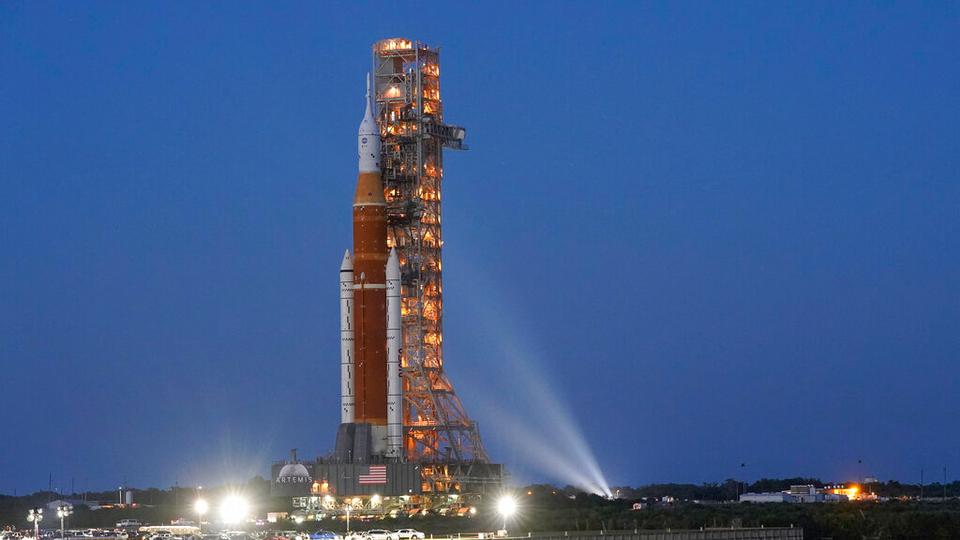
NASA’s
next-generation Moon rocket began a highly anticipated,
slow-motion journey out of its assembly plant en route to the
launch pad in Florida for a final round of tests in
the coming weeks that will determine how soon the spacecraft can
fly.
Rollout of the 32-storey-tall Space Launch System (SLS)
rocket and its Orion crew capsule marks a key milestone in US
plans for renewed lunar exploration after years of setbacks, and
the public’s first glimpse of a space vehicle more than a decade
in development.
The process of moving the 5.75-million-pound SLS-Orion
spacecraft out of its Kennedy Space Center Vehicle Assembly
Building began shortly after 5:30 pm EDT (2130 GMT) under
clear skies at Cape Canaveral. A nearly full moon rose about 90
minutes later.
The SLS-Orion, which cost some $37 billion to develop
including ground systems, constitutes the backbone of NASA’s
Artemis programme, aimed at returning astronauts to the Moon and
establishing a long-term lunar colony as a precursor to eventual
human exploration of Mars.
For the very first time, the integrated @NASA_SLS rocket and the @NASA_Orion spacecraft are leaving the Vehicle Assembly Building at @NASAKennedy. pic.twitter.com/ej4KmrP7qd
— NASA Artemis (@NASAArtemis) March 17, 2022
‘Most powerful rocket’
The spectacle was carried live on NASA Television and the
space agency’s website. A band from the University of Central
Florida played the National Anthem as the rollout began in front
of throngs of employees and other onlookers gathered outside to
watch the event.
“Ladies and gentlemen, the world’s most powerful rocket, right here,” NASA chief Bill Nelson told the crowd, gesturing toward the spacecraft minutes after the rollout started.
“Humanity will soon embark on a new era of exploration.”
Among those in the crowd was former astronaut Tom Stafford,
who orbited the Moon as commander of Apollo 10 in 1969, NASA
said in its webcast.
Your ride has arrived.
Today, @NASAGroundSys teams will begin to roll the @NASAArtemis I rocket four miles to the launch pad for its final prelaunch test.
Coverage begins at 5pm ET (21:00 UTC): https://t.co/z1RgZwQkWS pic.twitter.com/3D9Jvxfyu1
— NASA (@NASA) March 17, 2022
Dress rehearsal for launch
Once secured at the pad, the SLS-Orion ship is to be
prepared for a critical pre-flight test called a “wet dress
rehearsal,” which will begin on April 3 and take about two days
to complete.
The outcome will determine when NASA will attempt its first
launch of the rocket and capsule combination, a mission
designated Artemis I.
The US Apollo programme sent six manned missions to the Moon
from 1969 to 1972, the only crewed spaceflights yet to reach the
lunar surface. Artemis, named for the twin sister of Apollo in
Greek mythology, seeks to land the first woman and the first
person of colour on the Moon, among others.
But NASA has several steps to take before it gets there,
starting with a successful Artemis I flight, planned as an
uncrewed journey 64,374 km beyond the Moon and
back.
The Orion capsule will carry a simulated crew of three – a
male mannequin named “Commander Moonikin Campos,” in honour of
the late NASA engineer Arturo Campos, who played a key role in
bringing Apollo 13 back to Earth after an in-flight accident,
and two female mannequins.
All will be fitted with sensors to
measure radiation levels.

First human landing in 2025
NASA has said it was reviewing potential Artemis I launch
windows in April and May, but the timeline could slip depending
on the results of the dress rehearsal.
Eight or nine days after those tests are completed and the
propellant is drained from the rocket, the ship will be rolled
back to the assembly building to await the setting of a launch
date.
NASA announced in November that it would aim to achieve its
first human lunar landing of Artemis as early as 2025, preceded
by a crewed Artemis flight around the Moon and back in 2024.
Both of those missions, and others to follow, will be flown
to space by the SLS, which surpasses the Apollo-era Saturn V as
the world’s largest, most powerful launch vehicle, and the first
exploration-class rocket built by NASA for human spaceflight
since Saturn V.

Source: TRTWorld and agencies
NASA to test ‘most powerful rocket’ for Artemis launch
Source: Pinay Pop Showbiz


